When you look for nutrition advice, you may come across professionals using titles such as dietitian, clinical dietitian, nutritionist or sports nutritionist. Their services can appear similar, particularly when they offer meal planning, weight management or healthy eating guidance.
However, their education, professional training and areas of specialisation may differ. This can make choosing the right person confusing.
In India, the National Commission for Allied and Healthcare Professions (NCAHP) Act, 2021 includes both dieticians and nutritionists under the broader Nutrition Science Professional category. It identifies clinical and food service dieticians, as well as public health and sports nutritionists.
This means the difference between a dietitian and a nutritionist cannot be explained simply by saying that one handles medical conditions while the other only provides general food advice.
A more useful way to choose is to check the professional’s recognised qualifications, registration status, practical training, specialisation and experience with your particular needs.
This guide explains the dietitian vs nutritionist comparison in India and what to consider before booking a nutrition consultation.
What Is a Dietitian?
A dietitian is a nutrition and dietetics professional who applies scientific knowledge of food and nutrition to support individual and community health.
Dietitians may work in hospitals, clinics, food services, community health programmes, research settings and private practice. Their responsibilities depend on their qualifications, training and professional specialisation.
A clinical dietitian, for example, may work with people who need nutrition support alongside medical treatment. This can include individuals managing diabetes, cardiovascular conditions, digestive disorders or nutritional deficiencies.
What Does a Dietitian Do?
Depending on their professional training and scope of practice, a dietitian may:
- Assess an individual’s food habits and nutritional requirements.
- Develop meal plans based on health needs and food preferences.
- Provide nutrition education and dietary counselling.
- Offer medical nutrition therapy when appropriately qualified.
- Help people manage dietary requirements during treatment or recovery.
- Work with doctors and other healthcare professionals when necessary.
- Review progress and adjust nutrition recommendations.
Consider someone who has diabetes and needs help planning everyday meals. A suitably qualified clinical dietitian may provide guidance on carbohydrate distribution, meal composition and practical food choices alongside the person’s medical treatment.
A dietitian does not replace a medical doctor. Diagnosis, prescribing medicines and medical treatment remain within the relevant medical professional’s responsibilities.
What Is a Nutritionist?
A nutritionist is a professional whose work focuses on food, nutrition and their effects on health. Nutritionists may specialise in public health, sports nutrition, nutrition education, research or other areas of nutrition science.
Their work depends on their academic background and professional training. Some nutritionists have advanced qualifications in nutrition science, while others may have completed shorter courses.
The title alone does not establish a person’s level of education or clinical competence. It is important to understand the professional’s actual qualifications and the services they are trained to provide.
What Does a Nutritionist Do?
Depending on their education and specialisation, a nutritionist may:
- Explain how nutrients contribute to health.
- Support healthier everyday eating habits.
- Provide nutrition education to individuals and groups.
- Participate in community and public health nutrition programmes.
- Work in food and nutrition research.
- Provide sports nutrition guidance within their competence.
- Help people understand balanced meals and practical food choices.
For example, an active individual preparing for regular endurance training may seek help from a suitably qualified sports nutritionist. Guidance may cover meal timing, hydration, food choices and recovery nutrition.
Whether a nutritionist can provide clinical or disease-specific nutrition support should be assessed through their recognised qualifications, registration and professional competence, rather than their title alone.
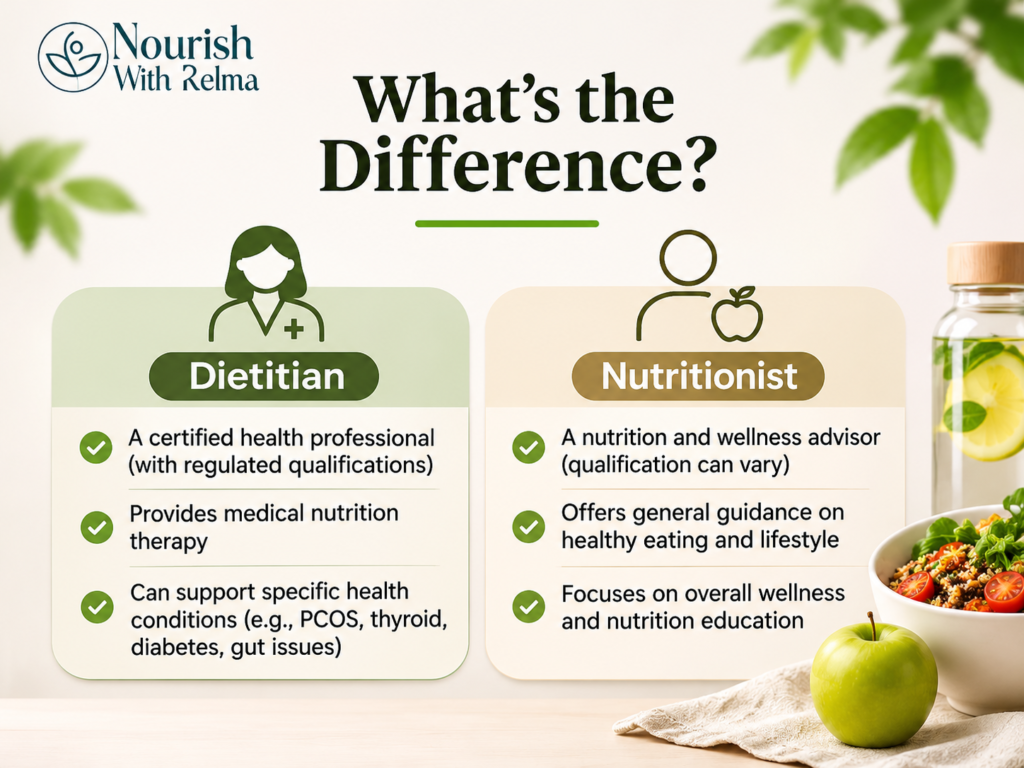
Dietitian vs Nutritionist: What Is the Difference?
Both professions have a foundation in food and nutrition science. Their work can overlap, but their professional designations and areas of specialisation are important when choosing someone for nutrition guidance.
Comparison factor | Dietitian | Nutritionist |
Professional focus | Nutrition and dietetics, including clinical and food service practice | Nutrition science, including public health and sports nutrition |
Common specialisations | Clinical dietetics, food service dietetics and other nutrition areas | Public health nutrition, sports nutrition and other nutrition areas |
Work settings | Hospitals, clinics, healthcare teams, food services and private practice | Community programmes, sports settings, research and public health |
Clinical nutrition support | Clinical dietitians with appropriate training may provide medical nutrition therapy | Depends on recognised qualifications, registration and clinical competence |
Meal planning | May develop individualised diets for clinical and general nutrition needs within their competence | May develop nutrition plans within their education and area of competence |
What to check | Relevant degree, clinical training, registration and experience | Relevant degree, specialisation, registration and experience |
This comparison is a general guide, not a strict division of every professional responsibility.
India’s NCAHP framework places dieticians and nutritionists within the broader Nutrition Science Professional category. The actual services a person can provide depend on their education, training, registration and professional competence.
What Does Indian Regulation Say About Dietitians and Nutritionists?
Understanding the Indian professional framework is useful when comparing nutrition professionals.
The National Commission for Allied and Healthcare Professions Act, 2021 includes Nutrition Science Professionals in its Schedule. It identifies two relevant designations:
- Dietician: Includes clinical dieticians and food service dieticians.
- Nutritionist: Includes public health nutritionists and sports nutritionists.
The Schedule describes a Nutrition Science Professional as someone trained in food and nutritional science, nutrition and dietetics who follows a scientific process to assess, plan and implement programmes that improve the impact of food and nutrition on health.
What changed with the NCAHP Registration Regulations, 2026?
The Ministry of Health and Family Welfare announced the Registration of Allied and Healthcare Professionals Regulations, 2026, under the NCAHP Act.
According to the Ministry’s announcement dated 7 October 2026, the framework provides for:
- State and Central Registers for recognised allied and healthcare professionals.
- Digital registration and Unique Identification (UID) numbers.
- Registration certificates with QR codes.
- Public verification of professional registration.
- Registration based on recognised primary qualifications.
- A five-year registration period, with renewal linked to Continuing Professional Development requirements.
The Ministry also states that professionals in a State or Union Territory without a functional State Council may register directly with the Central Register.
For anyone choosing a nutrition professional, the practical step is to ask about the person’s recognised qualification and applicable registration details. Where registration is available for the relevant professional category, verify the details through the appropriate official register.
What About the Registered Dietitian (RD) Credential in India?
The Indian Dietetic Association (IDA) has historically operated a Registered Dietitian examination and registration process.
However, an IDA update issued in 2025 states that its Registered Dietitian Board will no longer conduct RD examinations, with further accreditation moving under the Allied Health Council framework.
This is important when evaluating professional credentials. Do not assume that an older examination route is still available or that every person using a similar title has identical qualifications.
If a professional lists an RD credential, ask when it was awarded and what qualification or registration it represents. Consider it alongside the person’s current recognised qualifications, registration and practical experience.
Who Should You Consult for Your Health Goals?
The right professional depends on the type of support you need. Consider these examples before booking an appointment.
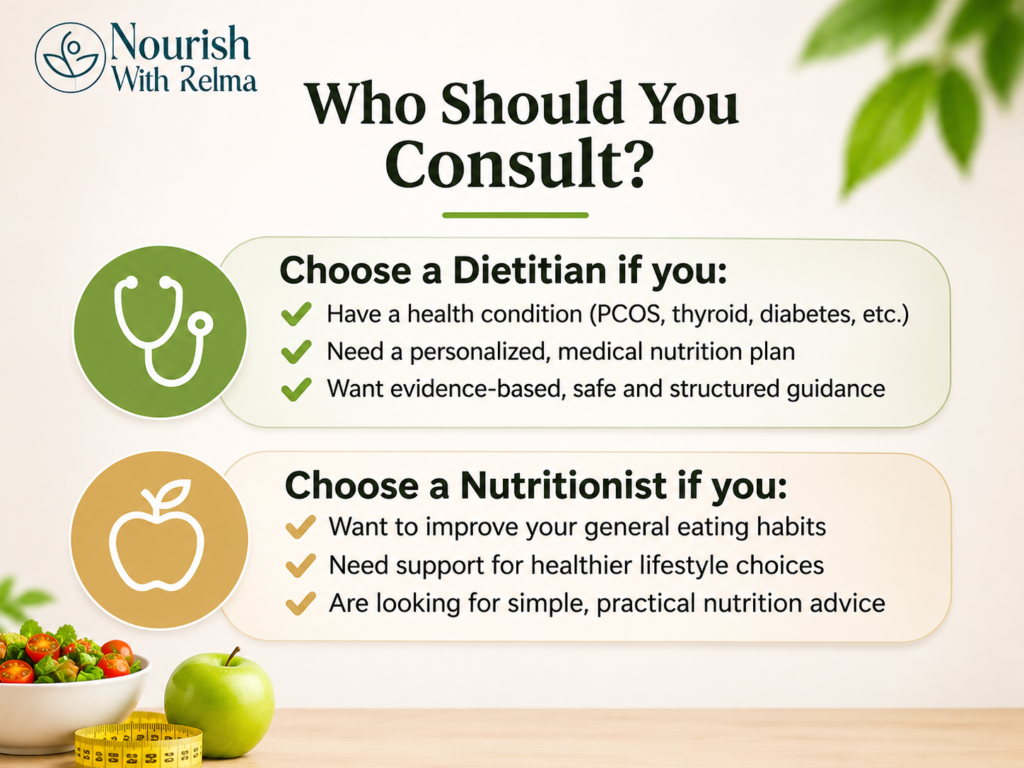
- For Diabetes and Other Medical Conditions
If you have diabetes, kidney disease, cardiovascular disease or another diagnosed medical condition, look for a clinical dietitian or another appropriately registered nutrition professional with relevant clinical training and experience.
Nutrition recommendations should complement your medical care. Your doctor remains responsible for diagnosis, medication and medical treatment.
- For Weight Management
A suitably qualified dietitian or nutritionist may support weight management, depending on their education and professional competence.
Look for someone who considers your food preferences, work schedule, health history, activity levels and eating habits. A plan should be practical enough to follow in your everyday routine rather than relying on a generic restrictive diet chart.
- For PCOS and Thyroid-Related Nutrition
People with PCOS or thyroid disorders may benefit from nutrition guidance that takes their medical history, symptoms, food habits and treatment plan into account.
Choose a professional with relevant experience in these areas. Nutrition support can contribute to overall health, but it does not replace medical diagnosis, prescribed medication or follow-up with your doctor.
- For Sports Nutrition
An athlete or physically active person may benefit from a dietitian or nutritionist with relevant sports nutrition training.
The professional should understand the person’s activity, training intensity, exercise duration, recovery requirements, hydration and food preferences.
- For General Healthy Eating
If your goal is to improve everyday food habits, plan balanced meals or understand nutrition better, a suitably qualified dietitian or nutritionist may be appropriate.
Check the person’s academic background and training to ensure their experience matches the advice you need.
Can a Dietitian and Nutritionist Do the Same Work?
Yes, their responsibilities can overlap in some areas, particularly general nutrition education, meal planning and healthy eating guidance.
For instance, both a suitably qualified dietitian and nutritionist may help someone improve everyday food habits. A professional with appropriate clinical training may also provide specialised nutrition support for people managing medical conditions.
The title alone does not establish whether someone is qualified to provide a particular service. Their education, supervised training, professional registration, competence and experience are more meaningful indicators.
How to Choose a Qualified Dietitian or Nutritionist in Mysore
If you are searching for a dietitian in Mysore, compare professionals based on their qualifications and suitability rather than choosing only by advertising, social media popularity or promised results.
Use this checklist before booking a consultation.
- Check Academic Qualifications
Ask about the professional’s degree or postgraduate qualification in nutrition, dietetics, food science or another relevant recognised field.
Check the awarding institution and whether the qualification meets the requirements for the professional category in which the person practises.
- Ask About Professional Registration
Ask whether the professional is registered under the applicable NCAHP or State Council framework.
Where registration is applicable and available, request the registration details or Unique Identification number and verify them through the relevant official register.
- Check Relevant Experience
A professional specialising in sports nutrition may not be the most suitable choice for a complex clinical nutrition requirement.
Look for someone whose practical experience matches your health goal.
- Understand the Consultation Process
A responsible nutrition consultation should consider your food habits, preferences, health history, daily routine and individual requirements.
Ask how the professional assesses your needs, develops recommendations and reviews progress.
- Be Cautious About Unrealistic Promises
Be careful if someone guarantees rapid weight loss, promises to cure a medical condition through food alone or advises you to stop prescribed medicines.
Nutrition support should be based on appropriate evidence and should complement medical care when required.
- Ask How Progress Is Reviewed
Your dietary requirements may change over time. Before booking, understand whether follow-up support is available and how recommendations are adjusted according to your progress and needs.
What Should You Expect During a Nutrition Consultation?
The consultation process varies between professionals, but a personalised nutrition discussion may cover:
- Your main health or nutrition goal.
- Current eating habits and typical meals.
- Food preferences, allergies and dietary restrictions.
- Work schedule, sleep and physical activity.
- Relevant medical history and ongoing treatment.
- Previous diet plans and difficulties following them.
- Practical meal-planning options.
If you have a diagnosed medical condition, take relevant reports and information about your current medicines to the appropriate healthcare appointment.
Do not change prescribed medication based on a diet plan without consulting your treating doctor.
How Nourish With Relma Connects with Personalised Nutrition
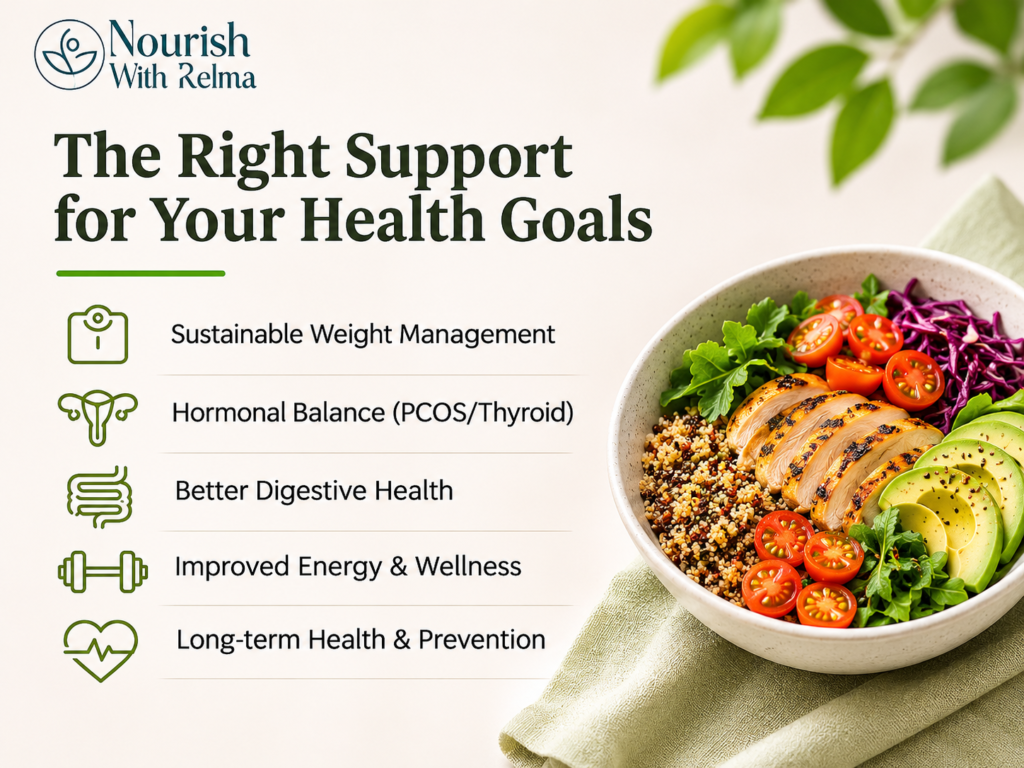
Nourish With Relma presents personalised nutrition guidance for people with different health and lifestyle goals. Its website lists services and areas of focus that include weight management, PCOS/PCOD nutrition, pregnancy nutrition, digestive health, sports nutrition and other nutrition-related needs.
The website describes a consultation process that includes booking an appointment, completing an assessment form, attending a one-to-one video call and receiving a personalised diet plan.
For someone looking for a dietitian in Mysore, this information can help them understand the available nutrition support and decide whether the consultation approach matches their requirements.
Before booking any nutrition service, check the professional’s qualifications, applicable registration and experience with your particular health goal. If you have a diagnosed medical condition, make sure nutrition guidance complements your existing healthcare.
Visit Nourish With Relma to explore its nutrition services and consultation options.
Dietitian vs Nutritionist: Which One Should You Choose?
There is no universal winner in the dietitian vs nutritionist comparison. The right choice depends on the professional’s qualifications, registration, specialisation and experience.
Consider the following when deciding:
- For clinical nutrition requirements: Look for a clinical dietitian or another appropriately registered nutrition professional with relevant clinical competence.
- For sports nutrition: Consider a professional with recognised sports nutrition training and practical experience.
- For general healthy eating: A suitably qualified dietitian or nutritionist may be appropriate.
- For community nutrition and public health: Look for a professional with relevant public health nutrition expertise.
If you are unsure, ask about the professional’s qualifications and scope of practice before beginning a consultation. For persistent symptoms or a diagnosed medical condition, involve your doctor where appropriate.
Conclusion
The difference between a dietitian and a nutritionist is not simply that one treats medical conditions while the other focuses on general healthy eating.
In India, both are included under the broader Nutrition Science Professional category in the NCAHP Act, with different professional designations and areas of specialisation. The 2026 registration framework also provides a system for professional registration and verification.
What matters when choosing someone is whether their education, registration, training and experience match your particular needs.
If you are comparing nutrition professionals in Mysore, take time to check their credentials and understand how they approach personalised nutrition before booking an appointment.
Disclaimer: This article is for general educational purposes and does not replace medical diagnosis or treatment. Dietitians and nutritionists are not substitutes for medical doctors. Consult an appropriate healthcare professional for medical concerns and do not stop prescribed treatment without medical advice.
Frequently Asked Questions
1. What is the main difference between a dietitian and a nutritionist?
A dietitian works in nutrition and dietetics, which can include clinical and food service practice. A nutritionist may specialise in areas such as public health or sports nutrition. Their work can overlap, so qualifications and professional competence matter more than the title alone.
2. Is a dietitian more qualified than a nutritionist?
Not necessarily. The title alone does not establish someone’s education or professional competence. Check the person’s recognised academic qualifications, registration, practical training and experience in the area where you need support.
3. Can a nutritionist help with medical conditions?
A nutrition professional may provide condition-related nutrition support when they have the appropriate recognised qualifications, registration and competence. For a diagnosed medical condition, choose someone with relevant clinical expertise and ensure that nutrition guidance complements your doctor’s treatment.
4. Should I consult a dietitian for weight management?
A suitably qualified dietitian can help with personalised meal planning and sustainable food habits. A nutritionist with relevant qualifications may also support weight management. Choose someone whose training and approach match your health needs.
5. Are dietitians and nutritionists recognised in India?
Yes. The National Commission for Allied and Healthcare Professions Act, 2021 includes dieticians and nutritionists under the Nutrition Science Professional category. The Registration of Allied and Healthcare Professionals Regulations, 2026 establish a framework for registration and professional verification.
6. What qualifications should I check before choosing a dietitian?
Ask about the person’s recognised degree or postgraduate qualification in nutrition and dietetics, relevant supervised training, professional registration details and experience in your area of need. Verify registration through the applicable official register where available.
7. Is a dietitian a medical doctor?
No. A dietitian is a nutrition and dietetics professional, not a medical doctor. Dietitians provide nutrition support within their professional competence, while doctors diagnose medical conditions and prescribe medical treatment.
8. How can I find a qualified dietitian in Mysore?
Look for relevant academic qualifications, applicable professional registration, experience with your health goals and a clear consultation process. Ask how the professional assesses your dietary needs and whether they coordinate with your doctor when necessary.