How Often Should You Meet a Dietitian in Mysore? Understanding Follow-Ups and Nutrition Support : There is no single follow-up schedule that works for everyone.
The right frequency for a dietitian follow-up in Mysore depends on why you are seeking nutrition support, what you are trying to achieve, how your routine is changing and whether your nutrition plan needs adjustment.
Some people may need closer support while they are developing new habits. Others may become comfortable with their routine and need fewer appointments over time.
A follow-up is not simply another visit to receive the same diet chart. It is an opportunity to discuss what happened since the previous consultation, identify difficulties, answer questions and decide whether your recommendations still fit your circumstances.
Is One Dietitian Consultation Enough?
For some people, an initial consultation may provide useful direction. However, nutrition needs and daily circumstances can change. After following a plan for a few weeks, you may discover that:
- Your work schedule makes certain meals difficult.
- You are struggling with particular portion sizes.
- Family meals make some recommendations difficult to follow.
- You are travelling more often.
- Your physical activity has changed.
- You need alternatives for certain foods.
- Your original goal has changed.
- Some parts of the plan are difficult to maintain.
These are situations where a follow-up can be useful. The purpose is not to make you dependent on appointments. It is to understand what is working, what is not and what may need to change.

How Often Should You Have a Dietitian Follow-Up?
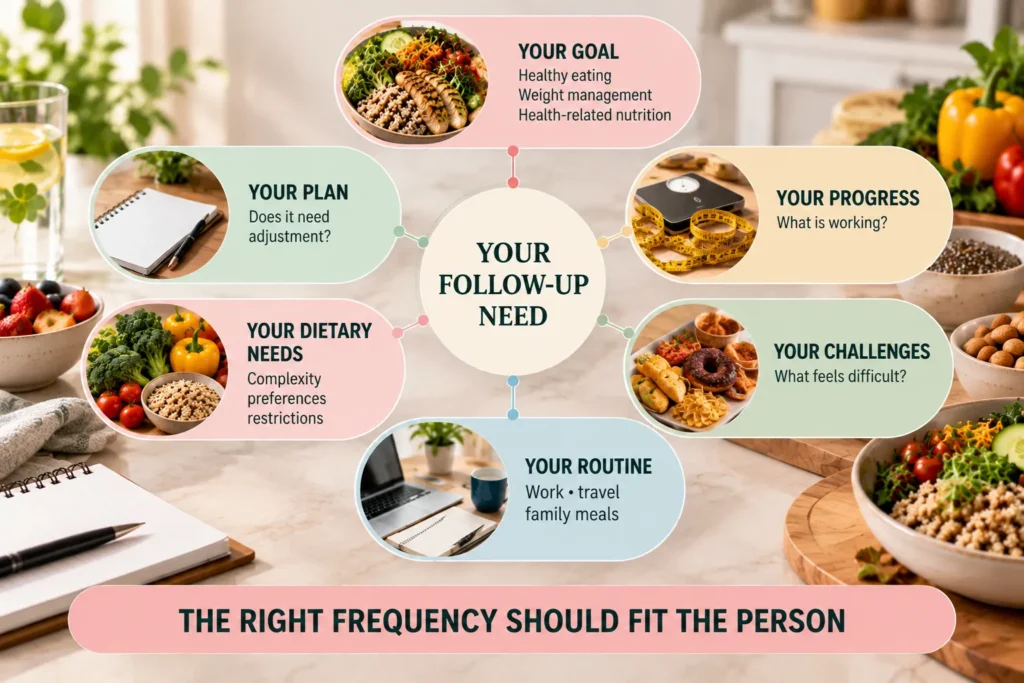
There is no universal number of days or weeks between dietitian appointments. The appropriate interval should be based on your goals, dietary needs, progress and professional assessment. Someone who is beginning to change long-standing eating habits may need more support while establishing a routine. Someone who is already comfortable with their nutrition plan may need fewer reviews. Follow-up frequency can depend on:
- Your main nutrition goal
- The complexity of your dietary needs
- How comfortable you are following the plan
- Challenges you are experiencing
- Changes in your lifestyle
- Progress towards your goals
- Relevant health circumstances
- Whether your nutrition plan needs modification
This is why a fixed rule such as “everyone should see a dietitian every two weeks” may not be appropriate. The schedule should fit the person rather than forcing everyone into the same timetable.
What Determines Dietitian Follow-Up Frequency?
Your Nutrition Goals
The reason you are seeking nutrition support matters. Someone working on general healthy eating may have different follow-up needs from a person seeking structured weight-management support or nutrition guidance related to an existing health concern. The purpose of each review should therefore relate to the goal established during the consultation.
Your Progress and Challenges
Progress is not limited to a number on the weighing scale. A follow-up can also look at whether you are able to:
- Follow the recommended eating pattern
- Manage portions
- Plan meals
- Make suitable food choices
- Maintain habits within your normal routine
If something is not working, the discussion can focus on why.
Changes in Your Routine
A plan may have been created around one routine, but everyday life can change.
A new work schedule, frequent travel, exams, family responsibilities or changes in physical activity can all affect the way you eat. A follow-up gives you an opportunity to discuss those changes instead of trying to force an old plan into a completely different routine.
Your Dietary Needs
Nutrition recommendations may need review when your dietary requirements or goals change.
The appropriate approach depends on the individual and should be determined through professional assessment rather than a fixed online schedule.
Identifying Barriers
Everyday barriers may include:
- Long working hours
- Frequent travel
- Eating outside
- Family meals
- Limited cooking time
- Irregular schedules
- Difficulty planning meals
- Social occasions
- Changes in activity levels
The discussion can focus on realistic ways to deal with these situations rather than simply asking you to follow the original plan more strictly.
Reviewing Progress
Depending on your goals and the type of nutrition support you are receiving, progress may be assessed using appropriate measures. This could include changes in eating habits, adherence to recommendations, lifestyle habits or other relevant indicators.
The specific measures should depend on your individual circumstances.
Adjusting Recommendations
If something is no longer practical or does not match your circumstances, the nutrition plan may need to change. This could involve:
- Changing meal options
- Adjusting portions
- Introducing food alternatives
- Modifying meal timing
- Changing the focus of your goals
A follow-up allows these changes to be discussed instead of treating the original plan as permanent.
When Might Your Nutrition Plan Need Adjustment?
You may want to discuss an adjustment if:
- Your work schedule has changed.
- You are travelling more frequently.
- Your food preferences have changed.
- Your physical activity has increased or decreased.
- You are struggling with a particular part of the plan.
- Your original goal has changed.
- Your eating routine has changed significantly.
- You need alternatives for certain meals.
- Your healthcare circumstances have changed.
A nutrition plan is not necessarily something that should remain unchanged regardless of what happens in your life. Follow-up gives you a chance to discuss what has changed and whether the recommendations should be modified.
Why Follow-Ups Can Be Useful for Weight Management
Dietitian follow-ups are sometimes viewed mainly as a way of checking whether the number on the weighing scale has changed. Weight management is broader than that. Nutrition and lifestyle habits can influence weight management, while physical activity, sleep, medicines, health conditions and other circumstances can also affect weight. A follow-up can therefore examine questions such as:
- Are your meals fitting your routine?
- Are your portions manageable?
- Can you maintain the recommended eating pattern?
- Are you experiencing frequent hunger?
- Are you having difficulty planning meals?
- Are weekends or social occasions creating problems?
- Have your lifestyle circumstances changed?
- Is the current approach realistic for the long term?
There is no responsible way to promise a specific amount of weight loss or a fixed timeline because individual responses differ.
Why Some People Need More Support at the Beginning
Starting a new nutrition routine can involve many decisions. You may initially have questions about:
- Portion sizes
- Meal combinations
- Snacks
- Eating outside
- Family meals
- Travel
- Food substitutions
- Weekend routines
- Exercise and meal timing
Some people may benefit from closer support while they become more comfortable making these decisions independently. That does not mean everyone needs frequent appointments. The level of support should reflect the person’s needs.
When Can Follow-Up Appointments Become Less Frequent?
Appointments may become less frequent when you become more comfortable managing your nutrition routine and have fewer issues that require professional review. You may become more confident about:
- Planning balanced meals
- Managing portions
- Choosing alternatives
- Handling restaurant meals
- Adjusting your routine during travel
- Recognising habits that interfere with your goals
- Making informed food choices independently
At that stage, future appointments may move from frequent troubleshooting to periodic review. The decision should still be individualised rather than based on a fixed timetable.
What Should You Ask During a Dietitian Follow-Up?
It is useful to bring questions to your appointment. You could ask:
- What should I continue doing?
- Which part of my routine needs the most attention?
- Can I modify this meal?
- What can I use as a substitute?
- What should I do when eating outside?
- How should I manage travel?
- What should I do if I miss a planned meal?
- Are my current goals still appropriate?
- What should I focus on before the next review?
- When should I schedule my next follow-up?
Writing down questions beforehand can help you make better use of the consultation.
What If You Are Struggling to Follow the Plan?
Tell your dietitian. A plan can look straightforward on paper and still be difficult to follow in real life.
If you are repeatedly struggling with meal preparation, timing, food availability, family eating patterns, travel or other practical issues, that information is important.
The solution may not simply be to “try harder.” The plan may need to become more realistic.
Personalised nutrition should take your circumstances and preferences into account rather than treating adherence as a matter of willpower alone.

How to Choose the Right Dietitian in Mysore for Your Health Goals: Finding a dietitian in Mysore is easy. Finding someone whose qualifications and approach fit your particular health goal takes a little more thought.
You may be looking for help with weight management, PCOS or PCOD, diabetes, digestive concerns, pregnancy nutrition, sports nutrition or everyday eating habits. The questions you should ask can differ depending on why you want nutrition support. Before booking an appointment, look at the professional’s qualifications, relevant experience, approach to personalized nutrition, communication and follow-up.
A useful question to start with is:
Does this dietitian understand my goal, and will the nutrition plan be adapted to my needs?
Can Follow-Up Help With Long-Term Nutrition Habits?
Ongoing nutrition support can help some people become more confident about food choices and maintaining healthier routines. Over time, the purpose of follow-up can shift towards helping you make appropriate decisions independently. This may include learning how to:
- Plan meals
- Adapt meals
- Manage portions
- Handle social occasions
- Make food substitutions
- Adjust to changing schedules
- Recognise when professional guidance may be useful again
The long-term objective is not necessarily to follow a diet plan indefinitely. It is to develop an approach that fits your life.
When Should Nutrition Support Be Combined With Medical Care?
A dietitian provides nutrition guidance, but a dietitian appointment should not replace medical diagnosis or treatment when those are required. Speak with an appropriate healthcare professional if you have symptoms or health concerns that require medical assessment, particularly when there are unexplained or significant changes in your health.
If you already have a medical condition, share relevant treatment information with your dietitian so nutrition recommendations can be considered appropriately. Nutrition support and medical care can work alongside each other when needed.
Dietitian Follow-Up in Mysore at Nourish With Relma
The supplied information describes Nourish With Relma as providing professional nutrition and dietary guidance from its location in Vijayanagar 1st Stage, Mysuru. The business information covers personalised nutrition and weight-management support, along with nutrition services related to areas such as weight management, digestive health, PCOS/PCOD, pregnancy nutrition, post-surgery recovery, stress management, hormonal health and sports nutrition.
If you have already completed an initial consultation, the appropriate follow-up frequency should be discussed according to your goals, circumstances and nutrition needs rather than following a fixed schedule.
Nourish With Relma
Address: 3rd Floor, Shoumik’s Shetty Mansion, 837, General Thimmaiah Rd, near Aishwarya Petrol Bunk, Vijayanagar 1st Stage, Vijayanagar, Mysuru, Karnataka 570016
Phone: 70197 64856
If you are considering ongoing nutrition support, contact Nourish With Relma to discuss your requirements and confirm current consultation and follow-up availability.
Final Takeaway
There is no single answer to how often you should have a dietitian follow-up in Mysore.
The appropriate frequency depends on your goals, progress, dietary needs, lifestyle and the amount of support you currently need.
A follow-up can be useful for reviewing what worked, identifying barriers, answering questions and adjusting recommendations when your circumstances change.
If you are finding your nutrition plan difficult to maintain, that does not necessarily mean you have failed. Discuss the problem during your next consultation. A personalised plan should be practical enough to work with your real life.
Frequently Asked Questions
1. How often should I have a dietitian follow-up in Mysore?
There is no fixed schedule that applies to everyone. Follow-up frequency depends on your nutrition goals, progress, dietary needs, lifestyle and whether your plan requires adjustment. Your dietitian can recommend an appropriate review schedule based on your circumstances.
2. Is one dietitian consultation enough?
An initial consultation can provide a starting point, but some people benefit from follow-up to review progress, answer questions and adjust their nutrition plan. The need for additional appointments depends on the individual.
3. What happens during a dietitian follow-up appointment?
A follow-up may involve reviewing your eating pattern, discussing progress and challenges, addressing practical difficulties, answering questions and modifying nutrition recommendations when appropriate.
4. Can a dietitian change my diet plan during a follow-up?
If your circumstances, goals or practical needs have changed, the recommendations may be adjusted. Any changes should be based on your individual situation and professional assessment.
5. Do I need dietitian follow-ups for weight management?
Some people find ongoing nutrition support useful for weight-management goals, particularly when they need help adapting meals, portions and eating habits to their routine. Follow-up requirements vary between individuals.
6. What if I am not able to follow my diet plan?
Tell your dietitian what is making the plan difficult. Problems with meal timing, work schedules, travel, food preferences or family meals can be discussed and may lead to more practical recommendations.
7. Can dietitian follow-ups become less frequent?
Yes. Once someone becomes more comfortable managing their nutrition routine and has fewer issues requiring professional guidance, follow-up appointments may become less frequent. The timing should still be individualised.
8. What should I ask during a dietitian follow-up?
You can ask about food substitutions, portions, meal timing, eating outside, travel, changes in your routine, progress towards your goals and what you should focus on before the next review.
9. Can I have a dietitian follow-up if I have a medical condition?
Nutrition support may be appropriate for people with health-related nutrition goals. However, medical conditions requiring diagnosis or treatment should also be managed with the appropriate healthcare professional. Share relevant medical information with your dietitian.
10. Where can I get dietitian follow-up support in Mysore?
Nourish With Relma is located at 3rd Floor, Shoumik’s Shetty Mansion, 837, General Thimmaiah Rd, near Aishwarya Petrol Bunk, Vijayanagar 1st Stage, Vijayanagar, Mysuru, Karnataka 570016. The supplied information lists the phone number as 70197 64856. Contact the business directly to confirm current follow-up availability and appointment details.